Dear Nobody
Dear Nobody is my Carnegie-winning young adults’ novel about love and unplanned teenage pregnancy, and is my most translated book. The dramatic and moving story of how the teenagers break the news to their parents, and how Chris and Helen find their way forward, is told in two voices. Dear Nobody is a TV movie.
Available from Amazon.
Published by Penguin, in the Originals series, 2016, ISBN 978-0141368948. Originally published by Hamish Hamilton London, 1991.
It was also available as a Collins playscript – see my Plays page. It has been performed at the Crucible Theatre, Sheffield; the New Vic Theatre, Stoke; and at many arts venues, schools and universities in Britain, Europe, Japan, fplaysAustralia and America, on BBC Radio 4 and on BBC television. It was also available as a video: BBC Schools TV production.
This website contains affiliate links. If you buy items using these links, I may receive a commission, at no extra cost to you.

Once she and I were the most important people in our world. Is this what I’d become to her? Nobody?
“Pregnant, pregnant, What if I’m pregnant?”
I have never read a book that evokes so vividly how it feels to be a teenager in love.
Daily Telegraph
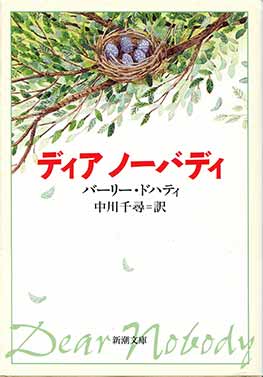
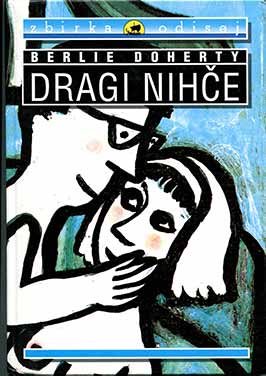
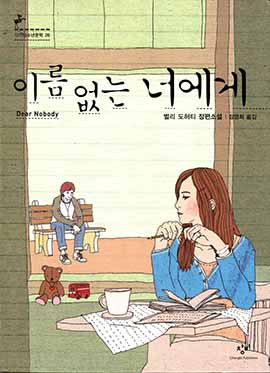
Dear Nobody was also published in Bulgaria, Catalonia, Denmark, France, Germany, Greece, Italy, Japan, Mexico, the Netherlands, Russia, Slovenia, South Korea, Spain, Sweden, Taiwan, Thailand, the USA and Wales.
See some of the covers at the bottom of this page!
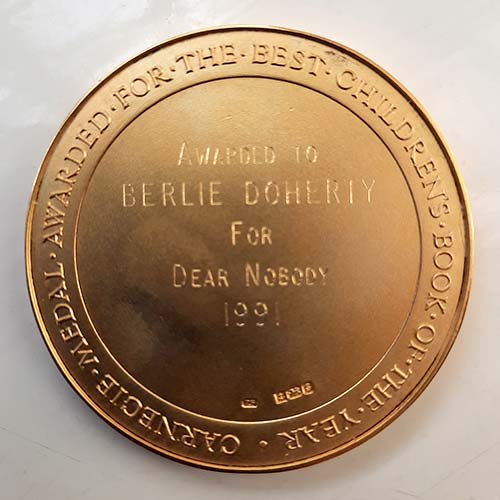
Dear Nobody won the Carnegie Medal 1991 and the Sankei Award (Japan), as well as being shortlisted for the Writers’ Guild of Great Britain Award, the Society of Authors Book of the Year, the Sheffield Award and the Federation of Children’s Book Groups Award. The stage version won the Writers’ Guild of Great Britain Award 1992.
Why I wrote about teenage pregnancy
I knew that in Dear Nobody I was handling a difficult situation. It is about two young people who love each other, but it’s also about the ways in which love can go wrong, and how sometimes it makes us do things that aren’t sensible or that hurt people. In a broad sense, it’s about family love and family relationships, how sometimes love turns to hate and drives people and families apart.
Dear Nobody was written at a time when contraceptives were not easily available and intimate relationships and contraceptive advice were not readily given. It’s not that long ago. So, when Helen finds out that she has become pregnant, she feels she has no one to turn to. She daren’t tell her mother. She daren’t tell Chris, because parenthood is not something they have ever contemplated – they’re too young for that. They have their own plans for the future – she will go to Manchester to study music, he will go to Newcastle University to study English Literature. She feels utterly alone.
And then they have to face their families. Even though they feel terribly alone with their dilemma, they can’t keep it from their families forever. Everything we do affects somebody else, often in a surprising way. Dear Nobody is not just about the journey that Helen and Chris make away from their childhood, but about the journey they make towards knowing their own parents properly.
The prose is honest and lovely and loving.
English Journal (USA)
‘Dear Nobody’: structure
But it isn’t just Helen’s story. Chris finds he is to become a father long before he is ready for it. If anything his sense of shock and fear is greater than Helen’s, because he’s powerless to make any choices about it.
Chris writes the story, as the main narrator. He explores not only his own emotions but also those of their two families. This was important for me. I wanted the book to work for boys as well as for girls, because boys are an equal part of the equation when it comes to making a baby. I wanted to imagine the sort of emotional upheaval that a situation like this might make in the life of a young man still at school.
Having decided that I was going to write the story from Chris’s point of view, I was setting myself a major problem. It is Helen who is pregnant. How was I going to explore the emotional and physical turmoil that she was going through? Who would she turn to? Then I had the idea of having her pour out all her feelings of fear and aloneness and wonder in a series of letters to her unborn child. At first she is not even sure that she is pregnant, it’s just a nightmare feeling that won’t go away.
So she writes a letter to nobody – and when I wrote down those first two words, Dear Nobody, I knew that I had the title of my book. That is one title that has never been changed in any of the translations – sometimes it’s even published with the English words Dear Nobody.
Having, very deservedly, won the Carnegie Medal in 1991 this book is a must read for any lover of UKYA and is now part of the Penguin Originals series. I felt sorry for Helen and Chris and simultaneously, I empathised with each of them separately.
Howling Reviews
How I did my research for ‘Dear Nobody’
I talked to lots of young people in schools when I wrote the novel. I didn’t want to write about their experiences, because I had the story and characters in my head by then. But I did want to know how people feel about love and friendship, relationships with parents, responsibility and loyalty, also about the bigger issues of teenage pregnancy, teen marriage, abortion and single parenting. Since I wrote the novel it has gone into many different languages all around the world, and into several different forms (plays for the theatre, radio and television, playscripts for schools).
I think maybe the reason why it has had such wide appeal is because the subject that it deals with – love, and all its complications, is something that affects us all in one way and another, and that really matters to us. Sometimes it’s embarrassing to talk about love, whether it’s physical or emotional, and a play or a story can help us to understand things that are difficult to handle.


This book is, above all else, honest – there are no easy answers and many hard decisions must be made, which lend sharp poignancy to the sensitive and skilful narrative. The prescriptive nature of National Curriculum reading should not prevent books like this being read as widely as possible. Buy a class set or get copies for the library.
Booksforkeeps
Some of the questions people ask me
Q What inspired you to write Dear Nobody?
A I knew a young girl who had been through a similar situation, and I saw then how deeply all the members of her family had been affected. But mainly I wanted to write about love, and how it would survive under very difficult circumstances. It helped a lot to talk to young people about love and friendship, loyalty and responsibility.
Q Would you write a sequel?
A People often ask me this. I don’t think a writer should always tell the reader what happens next. I think a book should leave the reader wondering. But one of my other books, The Snake-stone, looks at another side of a similar situation. In this book, a teenage mother finds a place to leave her baby boy and hopes someone will look after him. When he is fifteen he goes in search of her. It’s not a sequel but it looks at a similar situation from a different angle.
Nicole Katzenstein, Anna Neuhaus, Lena Donnermann, Miriam Kroining, Ina Tessel and Karoline Streck of Verl in Germany suggested a sequel to Dear Nobody could be about Helen’s life, Chris reappearing six years later, Chris abandoning his university place, Amy at the age of seventeen, etc. These are really interesting ideas but look how different they are!
Q Why is Helen’s mum so mean?
A If Helen’s mother had been more supportive Helen would not have found herself in such a lonely situation and she wouldn’t have needed to write the Dear Nobody letters. Alice doesn’t represent all mothers but I certainly know some who would react in just the same way as she did. Also, her real reason for distress is shown later in the book.
Wise, lyrical, and graced with rare insight and intelligence; not to be missed.
(Fiction. 11+) Kirkus reviews
Q Did this really happen to you?
A No, nor to my daughters, or my son.
Q Did you mean to write an issue book when you wrote Dear Nobody?
A I simply wanted to write a book which would be interesting to teenagers. I never want to write a message or a moral in my books – I don’t think that’s a novelist’s job. If I can write a strong story that moves my readers, then that is as much as I want to do.
Q How did you think of the ending?
A All the time I was writing the book I had no idea how it was going to end. It wasn’t until I got to the last few pages that I knew that for Chris and Helen this was the only possible solution.
Q How long did it take to write?
A About ten months. I wrote each chapter during the months that they are named after in the book!
Q What is your opinion on abortion?
A It is such a deeply personal matter that one cannot say simply that abortion is right or wrong, whatever the circumstances. What I do feel, very keenly, is that abortion is a very serious matter indeed and that anyone who finds themselves in the situation that Helen is in should be helped to be made absolutely aware of all the physical, moral and emotional aspects of it before attempting to make a choice.
Anyone needing advice and help and support could see the NHS’s teenage pregnancy support page.
Q Is there a play or movie of Dear Nobody?
A Yes. It has been a BBC Radio 4 play, a theatre play and a TV movie. CollinsEducation have published the playscript in their Playsplus series (currently out of print), and it has been performed in schools and theatres round the world.
Q Was it difficult to make the movie?
A I didn’t write the film script. It was written by Richard Cameron and I think he did it beautifully. Of course he made some changes but that’s necessary when you change from one medium to another. On the whole his changes pleased me. I’m in the film, by the way, in one of the café scenes! You can just see me behind Chris’s head!
Moving and very real.
Lovereading4kids
Q Do you think the characters in the movie represented the characters in the book well?
A As well as being on television, Dear Nobody has been two radio plays, two major theatre productions in England and one in Japan, and several school plays round the world! I have seen so many interpretations of Chris and Helen and the other actors that I almost can’t remember how I imagined my originals to be! I am just endlessly fascinated by the different ways of representing them, and always impressed by the actors’ ability to bring the characters to life.
Q What do you think of Helen, and how she deals with her situation?
A I think she is very strong-minded. She makes unilateral decisions which are sometimes quite selfish, such as her decision to break with Chris, and her decision to keep her baby. However, she is quite clear in her mind that she is making the right decisions, and I admire her for facing up to the emotional challenge that both these decisions entail. I don’t think her future will be at all easy.
Q Could you see Helen being placed within a different time frame altogether?
A Definitely. Helen’s dilemma is universal and timeless.
If you enjoyed reading ‘Dear Nobody’…
You may also enjoy The Snake-stone, which is a novel about teenage pregnancy and adoption.
Other YA family stories are Granny was a Buffer Girl, Jeannie of White Peak Farm, The Girl Who Saw Lions and Deep Secret.


Seven Stories – The National Centre for Children’s Books has a very informative blog on Dear Nobody.
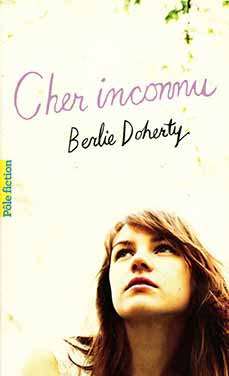
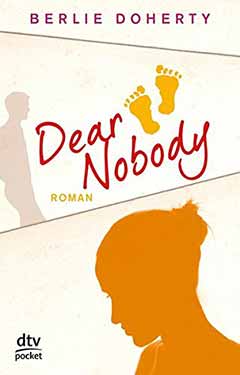
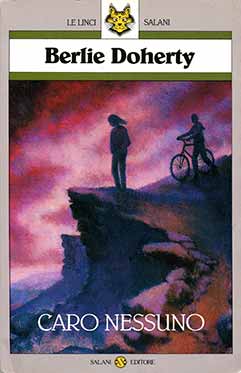
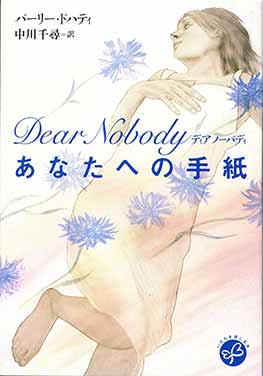
Some of the many foreign editions of ‘Dear Nobody’ over the years!